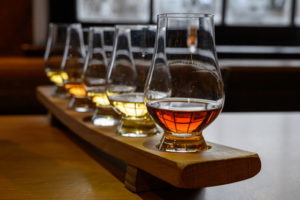
 Whether you regularly enjoy a ‘wee dram’ or have never touched a drop of the stuff, virtually everyone will at least know that whisky is an alcoholic drink. In some ways, it is the most complex alcoholic drink that there is, boasting different spellings, let alone the countless flavours you can experience with it. Closely associated with Scotland, whisky is an alcoholic drink made from fermented grain mash.
Nowadays you can buy whisky from as far afield as Japan and India, with the likes of the Swedish, the Taiwanese and the Australians all having a bash at producing their own versions of it. The word comes from the Gaelic word ‘uisce’, which means ‘water’, thanks to the fact that distilled alcohol was called ‘aqua vitae’, or ‘water of life’. There is so much to tell you about whisky, so let’s get into it.
What is Whisky?
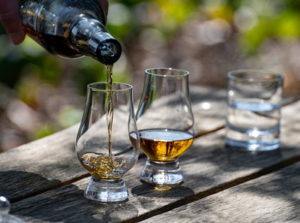 An amber coloured liquid that is made from fermented grain, whiskies are often aged in a wooden cask before being bottled. As an alcoholic spirit, whisky typically boasts a minimum alcohol by volume percentage of 40%. A whisky is usually distinguished by where it is from, the type of grain used to make it, the blending process and the manner in which it has been aged.
The grains that are most commonly used to create whisky are rye, wheat, corn and barley. Each has its own flavour and personality, meaning that the warmth, spiciness, sweetness or caramel-nature of the whisky, to offer some examples, can be dictated according to the grain that was chosen. Once created, the liquid is aged in wooden casks, with thy type of cask chosen also having an influence on the flavour.
Quite where whisky was invented remains a mystery. The art of distillation might well have been introduced to Scotland by Christian monks, with the earliest records of distilling for the purposes of alcohol coming from Italy in the 13th century. Ireland and Scotland, meanwhile, will both have learned the European practice of distilling for medical purposes in the 15th century at the latest.
Whisky or Whiskey?

One of the constant debates around whisky comes in the form of its spelling. You’ll likely hear some people say that it is spelt one way if it’s Scotch and another it it isn’t, but that’s not really true. The reason for the different spelling is due to the derivations of Gaelic from the early days of the sprit being introduced to the world, back when ‘Uisce beatha’ was used and meant ‘water of life’.
The Irish immigrants to America took the drink with them and spelt the word with the ‘e’ included, whilst the Scottish did not. The words themselves mean largely the same thing, being as they are mere varieties of the same alcoholic drink. Whisky from Scotland, often referred to simply as ‘Scotch’, is always spelt without the ‘e’, whilst Irish and American whiskeys always have the ‘e’ included in the word.
In essence, therefore, it matters how you spell it if you want to avoid upsetting people. Other variations of the drink will tend to adopt the spelling of the country that they most closely copied, which is why it is spelt ‘whisky’ in Japan, where the whisky makers learnt their trade from Scottish academics. Of course, it doesn’t matter how you spell it when you’re busy drinking it down.
Types of Whisky
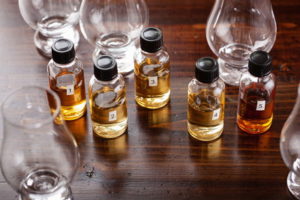 When it comes to the different types of whisky that there are to drink, you have a wealth of different ones to choose from. The most common form of whisky is malt whisky, so named because it is primarily made of malted barley. Even that isn’t all that straight forward, though, given that you can have single malt whisky or blended malt whisky, each of which will have its own personality.
Single malt is often thought of as being the ‘purest’ form of whisky. It is made from a single distillery and the mash will be made up of a singular grain type. You might find a whisky labelled as being ‘single cask’, which means that the whisky has been matured in just one cask. This is rare, however, with most whiskies produced using many different casks and even different years to create a recognisable taste.
It’s common for single malts to bear the name of the distillery as well as the age statement and information on any special treatment that the whisky was given. As you might imagine, a blended malt involves mixing single malts from different distilleries together. Also referred to as ‘pure malt’, ‘vatted malt’ and even merely ‘malt’, if it doesn’t have the word ‘single’ in its title then it is going to be a blend.
Blended whisky, meanwhile, is made from different types of whisky and is blended to taste. A blended whisky will commonly contain whiskies from numerous different distilleries, meaning that the distillery’s name will often be left off the bottle. The majority of whiskies from Scotland, Ireland and Canada are blends, with American blended whiskies also including neutral spirits.
American whiskeys are something else entirely. They are usually under 80% in alcoholic volume and are aged in new oak barrels, which tends to make them sweeter than their American counterparts. Though American single malts is a fast-growing market, it is not what the country is best known for. Bourbons are probably the United States’ most famous export on a whiskey front, with Tennessee mash, such as Jack Daniels, taking the crown.
Scotch
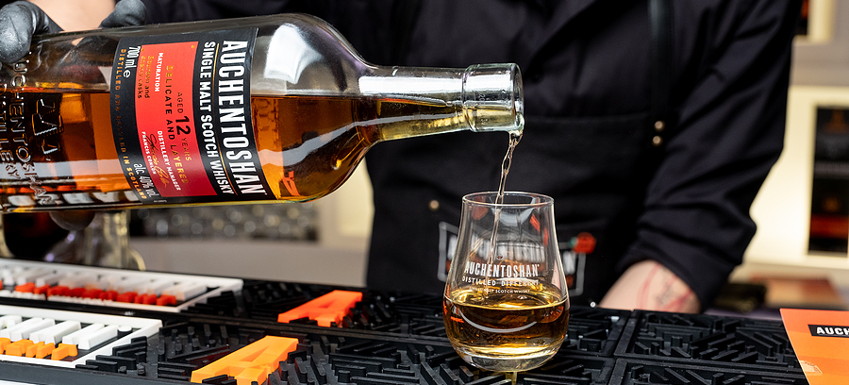
In order to be called a Scotch whisky, it must be made from malted barley and aged for at least three years. It obviously also needs to be made in Scotland, meaning that it will fall into one of the following categories:
- Lowland
- Highland
- Islay
- Speyside
- Campbeltown
Starting with the Lowland whiskies, these are typically quite light and mild-boded. There are three distilleries in operation in the Lowlands at the time of writing, made up of Glenkinchie, Bladnoch and Auchentoshan. The latter of these is the whisky that has become the most popular in recent times, perhaps thanks to its odd name and the fact that it tends to be reasonably well-priced.
Highland whiskies are often considered to be light and fruity, with maybe a little bit of spice thrown in there for good measure. The Highlands is the largest part of Scotland, geographically speaking, with countless different distilleries existing in the area. As a result, there is no one taste that reviewers can point to and easily sum up what a Highland whisky is likely to offer.
Islay whiskies are ones that many people feel as though they either love or they hate. This is thanks to the smoky and peaty nature of the drink, with a hint of salt on account of the fact that the area is surrounded by sea. This is not the whisky that you want to start off your whisky-tasting experience with, given that there’s a real chance that it could put you off forever if it is not a whisky for you.
Speyside whiskies are named in honour of the river Spey, which cuts through the area and adds to the taste of the drinks produced there. Around half of all Scottish distilleries are based in Speyside, which is at the top of the Highlands. The whiskies produced here tend to be the most complex of the bunch, offering a rich taste and some sweeter tones that add to their allure.
Finally we look to Campeltown, which is closer to Islay both geographically and in terms of what you can expect to enjoy from the whiskies produced there. The drinks made in Campeltown are heavily influenced by the sea, meaning that you can expect to get a slightly salty taste in the notes produced. At the time of writing, Glengyle, Glen Scotia and Springbank are the distilleries still in production there.
Irish Whiskey
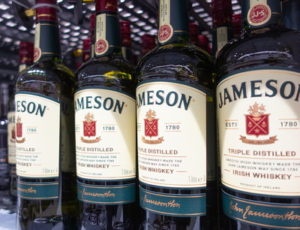 You can expect just as varied an experience when tasting Irish whiskey as you can drinking Scotch, with the main difference being the fact that they tend to be less peaty when made in Ireland. Irish whiskey is traditionally triple-distilled in a copper pot, which goes against the double distillation that Scottish whiskies experience. Irish whiskeys tend to be broken down into a classification, explaining what you can expect to taste.
Single malts are, as explained elsewhere, made from a malted barley in a single distillery. Grain whiskeys, meanwhile, are lighter in style and are made with a grain or a corn and produced in a column still. You can have single grain whiskeys as well as blended ones, with blended making up about 90% of Irish whiskey.
One thing that is unique to Ireland is the single pot still whiskey, which is so-named because of its unique distillation process. This involves blending a malted barley with an unmalted barley to produce a taste that is specific in nature. As with Islay whiskies, you should be careful not to jump to conclusions about all Irish whiskey off the back of trying just one, given that they can offer incredibly different tastes.
American Whiskey
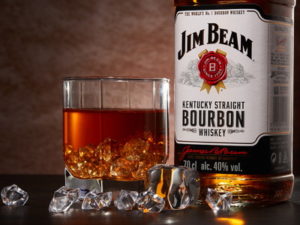 Anyone that has ever been to American will be unsurprised to learn that their whiskeys are a bit sweeter than European alternatives. There are five different categories that American whiskeys fall into:
- Bourbon
- Tennessee
- Rye
- Wheat
- American Single Malt
In order to be a bourbon, a whiskey must be made of 51% corn mash. Originally produced in Kentucky, it is now made coast to coast and can be found in the likes of New York, California and Indiana. It is different from Tennessee whiskey on account of the fact that the latter goes through a charcoal filtering process in order to mellow it out. Tennessee mash, like Jack Daniels, is technically not a whiskey at all.
Indian, Japanese, etc.
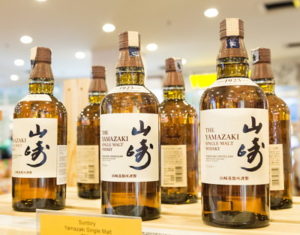 Nowadays, there are a wealth of what one might refer to as ‘hipster’ whiskies, produced by more far-flung and unexpected of countries. Arguably the fastest developing of these is Japan, which are most similar to Lowland Scotch and Speyside whiskies. This is at least partially thanks to the fact that it was Scottish academics that introduced the drink and helped the Japanese learn how to make it.
One way of thinking about Scottish and Japanese whiskies is by comparing it to the production of wine in France and California. One of the producers started it all and boasts tradition, history and even topography to speak of. The other, meanwhile, is newer but has innovation, focus and technology on its side. Both are producing great whiskies, but they’re approaching it in a different way to each other.
There is some debate as to whether Indian whisky is actually even whisky at all. The majority of the domestically produced product is from molasses, meaning that it’s closer to rum than whisky. Even so, India is a huge whisky drinking country and there are definitely some lovely tipples to be found if you know where to look and what it is that you’re looking for.
The likes of Canada, Sweden and even Taiwan have begun producing whiskies of their own over the years. You can buy English whisky, Welsh whisky and whisky from the Isle of Man if you want to stick within the British isles, or you can look to somewhere such as France or Germany should you wish to try something a little bit different. They all have their own unique take on whisky as a drink, some of which works and some that doesn’t.
Why Is Whisky Aged / Matured?
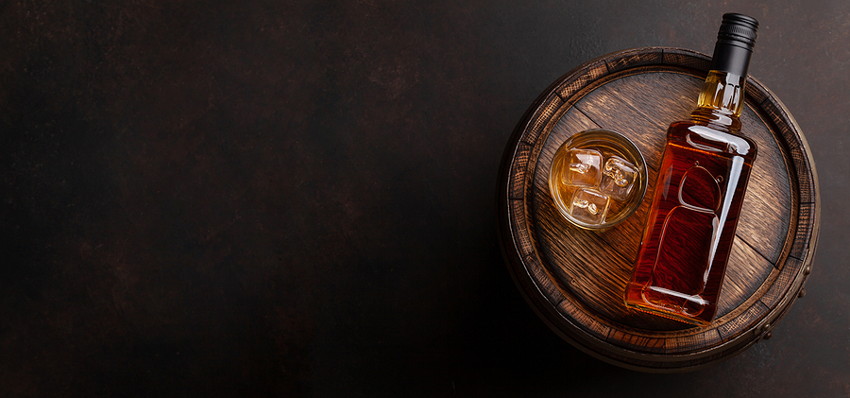
It might seem odd for distilleries to leave their product maturing before getting it onto the market. After all, if they sold it straight away then they could make a profit on their creation sooner rather than later. In reality, however, the maturation of whisky is exactly what makes it such a popular drink. The newly created liquid interacts with the wood to add different flavours and experiences to drinking whisky.
In order to qualify as a Scotch, a whisky needs to have been left to mature in an oak barrel for at least three years. There is no maximum limit on how long they’re left for, so it’s not uncommon to find whiskies that have been maturing for as long as 50 years. The longer you leave something in a barrel, the more it is going to soak up the characteristics of the barrel that it has been placed in.
This is why American whiskeys tend to be removed much sooner, capturing the sweetness. They are also put in new barrels, whereas Scotch is matured in second-hand ones that have previously stored something else within them. You could technically drink a Scotch immediately after production, but it would lack the peaty nature and smokiness that makes a Scotch so enduring.
Interestingly, when a whisky is first produced it is virtually clear. It is the maturation in the barrels that add the colour to the drink as well as the flavour. The barrel itself as well as the environment that said barrel is kept in are two of the key factors that influence a whisky’s flavour. Without the maturation period, this wouldn’t happen and that would mean that you’d be drinking something more like moonshine than whisky.
Whisky Barrels
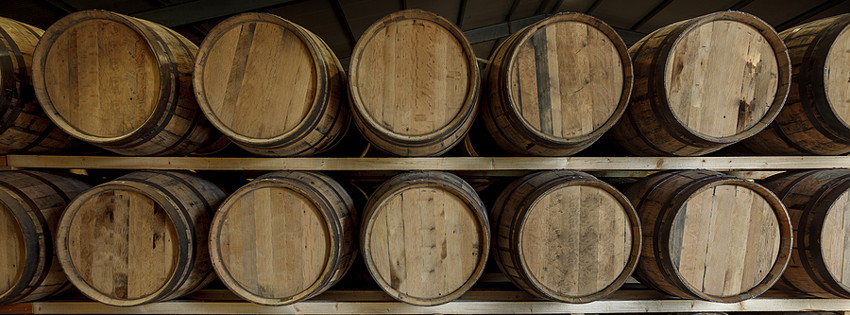
The fact that the barrel that a whisky is stored in for the maturation period has such a big effect on the flavour of the drink when it is ready to go means that whisky makers enjoy playing with the barrels that they use. The maturation period is arguably the most important part of making a whisky, which is why different woods are used to see what can happen in such an instance.
Interestingly, it’s not just the wood that the barrel is made of that makes a difference. Even the size of the barrel can influence a whisky’s flavour, so that needs to be taken into account by distilleries. Imagine how different a drink will taste if it has been left to mature in a barrel that had previously housed a red wine, say, when compared to a white win. A port compared to a dark rum.
These are the things that whisky makers have to think about, putting the benefit of having the whisky mature in an oak barrel alongside a maple one to see what difference can be experienced. Take a whisky that has been stored in one and compare it to the other and you’ll see huge differences, let alone if one of them has previously stored white port and the other a chardonnay.
Does Whisky Have to Be Expensive to be Good?
 There are numerous things that can alter the price of a whisky, up to and including the fact that the maturation process itself can be a pricy one. A whisky being expensive doesn’t in and of itself mean that it is going to be good to drink, just as a whisky being cheap doesn’t immediately mean that it is going to be disgusting. The truth is that there is no one, definitive answer to whether whiskies have to be expensive to be good.
As with so many things in life, personal preference will be crucial when it comes to what you think of a whisky. You could try the most expensive Islay whisky on the planet, but if you don’t like peaty whiskies then you’re not going to enjoy it. That being said, whiskies mature with age and it costs money to keep them stored, meaning that the older whiskies will probably be both the tastiest and the most expensive.
How To Store Whisky
 There’s little doubt that the storage conditions of a whisky can have an effect on its flavour. Typically speaking, the best way of storing a whisky is below room temperature and with the bottles standing up. If you want to be even more specific, keeping them in the dark is a good idea. How a whisky is stored definitely matters, but ultimately it will change the taste and you’ll have to decide for yourself if that’s a good thing.
You might accidentally leave a whisky in the sunlight, for example, and decide that it makes the flavour better for you. Equally it’s not out of the realms of the possible that you put the whisky in the freezer and enjoy the coldness and the wateriness that comes with that. There is unquestionably a correct way to store whisky up to an including not having too much air in the bottle, so do your best to get it right.
Most Expensive Whisky
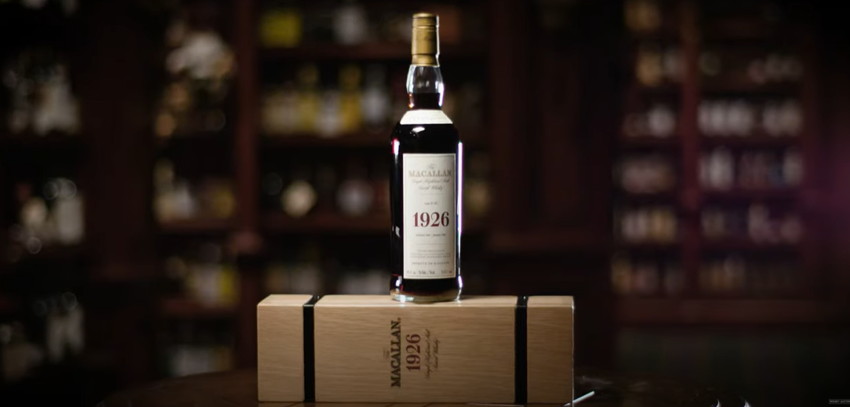
When it comes to expensive whiskies, the sky is the limit. For example, a bottle of Macallan 1926 Fine and Rare 60-Year-Old whisky went up for auction with a guide price of between £350,000 and £450,000. It sold for £1,452,000. Forbes recently did an article about expensive whiskies, drawing attention to the likes of the Mortlach 75 Years Old that cost $32,000.
Here’s a quick look at some expensive whiskies and what you can expect from them, should you be able to afford to buy them:
Macallan Lalique 50 Year Old Single Malt Scotch – Average Price of £151,800
The Macallan boasts a lovely, unique look to its bottle, with its Speyside origin promising sweet flavours. You can expect to enjoy aromas of maraschino and cumin, plus flavours of dark chocolate and prunes.
Bowmore ‘Black Bowmore’ The Last Cask 50 Year Old Single Malt – Average Price of £56,000
The Black Bowmore from 1926 is unrivalled, but if you can’t afford that then maybe you can try the 1964 instead. Orange peel, black cherry and mango flavours can all be experienced, whilst the finish promises a slight hint of spice.
Karuizawa 48 Year Old Single Cask Malt Whisky – Average Price of £51,400
Proof positive that it’s not just the Scotches that cost big money, this Japanese whisky was matured in the barrel for 48 years. The distillery that made it is now closed, adding to the price, but the rich oak and dark sugar flavours also help.
Midelton Very Rare Silent Distillery Collection ‘Chapter 1’ 45 Year Old Single Malt – Average Price of £43,100
Irish whiskeys aren’t for everyone, but this one was aged in a sherry cask and promises a slightly peaty flavour. It begins with a touch of oak before developing into a tropical fruit taste, with slated caramel also coming through.
Springbank 50 Year Old Single Malt – Average Price of £35,000
It is only right that we finish this section back in Scotland. The Springbank 50 Year Old Single Malt whisky looks quite pale in the bottle, but that is not a bad thing when it comes to the flavours. It was released to celebrate the millennium.
Whisky As An Investment
 The very nature of whisky is such that it gets better with age, therefore meaning that buying it as an investment makes sense. The trade in old or rare bottles of whisky has been around almost as long as the drink itself, but the idea if investing in whisky is a relatively new one. What you need to decide is whether you want to ‘flip’ them for a short-term profit or play the long game with them that allows you to make some serious money.
As an example, if you’d bought a bottle of Black Bowmore in 1993 it would have cost you about £100. Nowadays, bottles of the same drink sell for around £50,000. With that in mind, if you can get your hand on a special edition whisky when it is first released and keep it in optimum conditions, the likelihood is that it will be worth significantly more a little bit further down the line.
When it comes to buying whisky as an investment, it is crucial to ensure that you store it correctly. A whisky connoisseur will almost certainly be taking you to court if they’ve bought a bottle of whisky from you for tends of thousands of pounds only to find out that it has been kept in sunlight and varying temperatures, making it virtually undrinkable. Make sure you know what you’re doing before you take the plunge.